A successful buy and build strategy depends on a consistent flow of acquisition opportunities. USP Data helps corporate finance advisers, private equity firms and acquisitive businesses identify acquisition targets, build buyer universes and manage acquisition pipelines using researched industry sectors, financial screening and company intelligence.
How to Build Buy and Build Acquisition Pipelines
Home / How to Build Buy and Build Acquisition Pipelines
Buy and Build Acquisition Strategy: How to Build Acquisition Pipelines
Why Most Buy and Build Strategies Fail
Most buy and build strategies do not fail because of a lack of ambition or funding. They fail because the acquisition pipeline is too small, too narrow or becomes outdated.
Acquisitions are notoriously difficult to complete. Many business owners are not ready to sell when first approached, some opportunities fail during due diligence, and others simply prove to be a poor strategic fit. As a result, successful acquirers recognise that buy and build is largely a numbers game. It is rarely enough to identify a handful of attractive targets and hope that one progresses to completion.
The most successful acquisition programmes maintain a large and continually refreshed pipeline of opportunities. Rather than focusing all efforts on a small number of prospects, they ensure that multiple conversations, investigations and opportunities are progressing simultaneously. This increases the likelihood of transactions completing and reduces the risk of the entire programme stalling when an individual opportunity falls away.
Another common problem is that acquisition research is often fragmented across spreadsheets, emails and individual team members. Lists become out of date, research is duplicated and potentially valuable opportunities are lost or forgotten. As acquisition programmes expand across multiple sectors and geographic regions, managing the pipeline becomes as important as identifying the targets themselves.
USP Data has been designed to address these challenges. Users can identify opportunities across more than 1,700 sectors, screen companies using detailed financial and ownership criteria, save and organise targets within the built-in CRM and monitor opportunities over time. This makes it possible to manage multiple concurrent acquisition projects from a single platform, ensuring that there are always new opportunities entering the pipeline as others progress, pause or drop out of consideration.
Step 1: Market Mapping and Sector Selection
Every buy and build strategy begins with selecting the right target market. Before identifying acquisition candidates, it is important to establish whether the sector itself offers sufficient opportunity to justify a consolidation programme.
There is little point in pursuing a roll-up strategy in a market that is already heavily consolidated or where there are only a handful of owner-managed businesses of sufficient size to make a meaningful contribution to the growth of the group. For this reason, the first stage should often be market mapping rather than acquisition target identification.
USP Data provides access to more than 1,700 sector classifications, including over 1,000 researched industry sectors and approximately 700 SIC-based sector reports. This allows users to review potential markets, assess the number and profile of acquisition candidates and identify sectors where a buy and build strategy is most likely to succeed. In many cases, this process highlights opportunities in adjacent sectors that may offer a larger pool of acquisition candidates than the market originally under consideration.
Where the target market has already been identified, organisations can subscribe only to the sectors relevant to their acquisition programme. This can provide a highly cost-effective solution for investors, corporate finance advisers and acquisitive businesses focused on a limited number of industries. As a general rule, where fewer than nine sectors are required, a sector-specific subscription will often represent the best value. Beyond this point, the full USP Data subscription typically becomes the more economical option, providing access to the complete library of sector reports which while not immediately relevant for acquisitions may be crucial for organic growth by finding more customers like the best customers already onboarded.
Step 2: Build the Acquisition Universe
Once the target market has been selected, the next step is to build a comprehensive universe of potential acquisition candidates. The objective at this stage is not to create a shortlist immediately, but to identify every company that could plausibly contribute to the buy and build strategy. Acquisition universes should not be restricted to direct competitors. Many successful buy and build programmes combine businesses from adjacent sectors, complementary services and related markets to create a larger pool of potential opportunities.
This often involves looking beyond a single sector. Whilst the core market may provide the starting point, attractive acquisition opportunities are frequently found in adjacent sectors, complementary services and related specialist markets. By combining companies from multiple sector reports, acquisition teams can create a broader acquisition universe and avoid restricting their search to the most obvious targets.
USP Data is deal origination software which allows users to screen companies using a combination of financial, geographic and ownership criteria, enabling the acquisition universe to be refined to those firms that meet the broad requirements of the strategy. Factors such as profitability, size, growth, location, ownership profile, shareholder age and financial strength can all be incorporated into the search process.
The resulting universe of companies can then be analysed and ranked using a niche sector report focused specifically on the firms of potential interest. This allows acquisition teams to compare opportunities, identify the strongest candidates and prioritise their efforts towards the companies most likely to deliver strategic value. Rather than working through an unstructured list of businesses, users can focus on a ranked and researched population of potential targets, ensuring that management time is directed towards the opportunities with the greatest potential impact.
Step 3: Prioritise Platform and Bolt-On Opportunities
Not all acquisition targets play the same role within a buy and build strategy. Some businesses may represent platform acquisitions capable of supporting future growth, whilst others may be bolt-on acquisitions that add customers, geographic coverage, specialist expertise or complementary services.
Identifying the distinction early helps acquisition teams allocate resources more effectively. Platform acquisitions are often expected to provide the management capability, infrastructure and financial strength required to support future acquisitions, whereas bolt-on acquisitions are assessed according to their ability to strengthen and expand the platform.
USP Data allows users to segment acquisition candidates according to turnover, profitability, ownership profile, geographic reach and sector specialisation, helping acquisition teams prioritise opportunities according to their likely role within the wider acquisition strategy.
Step 4: Prioritise and Rank Opportunities
At this point the acquisition universe may contain hundreds of companies depending on the sector selection. The challenge is no longer identifying opportunities but deciding where management time should be focused.
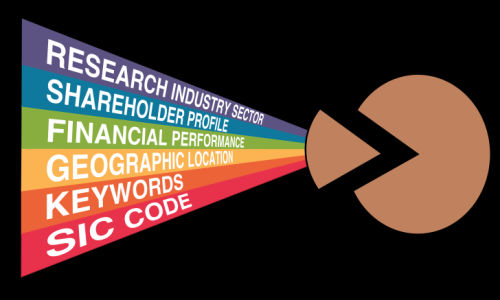
USP Data allows users to analyse and compare acquisition candidates using financial performance, profitability, growth, ownership characteristics, geographic fit and other strategic criteria. Companies can be ranked, grouped and compared using niche sector reports and benchmarking tools, helping acquisition teams identify the opportunities most likely to contribute to the buy and build strategy. The CRM could be used to have several projects best prospects, potentially attractive prospects and other firms of potential interest. Organising in this way will prevent duplication of effort and saving of the outreach marketing budget.
This process ensures that outreach efforts are concentrated on the highest-priority targets rather than being spread evenly across a large population of potential candidates. As circumstances change, rankings can be updated and the acquisition pipeline refined without having to repeat the original research.
Step 5: Engage and Track Opportunities
Once priority acquisition candidates have been identified, the focus shifts from research to engagement. At this stage, acquisition teams begin approaching business owners, advisers and intermediaries to establish whether opportunities exist and to assess the level of interest in a potential transaction.
Not every conversation will lead to a deal. Some owners will not be ready to sell, some businesses will fail to meet expectations during further investigation and others may not be available at the right valuation. For this reason, it is important to manage multiple opportunities simultaneously and maintain a steady flow of new prospects entering the pipeline.
USP Data’s built-in CRM allows users to record contact activity, store research notes, organise opportunities into project groups and monitor the progress of individual acquisition discussions. This ensures that all intelligence gathered during the acquisition process remains accessible and can be reviewed as circumstances change.
The objective is not simply to create a list of targets, but to build and maintain a pipeline of active acquisition opportunities capable of supporting a long-term buy and build strategy.
Example: Wealth Management Buy and Build Strategy
An adviser working on a buy and build strategy within the wealth management sector subscribed only to the Wealth Managers and Financial Advisers datasets.
After applying profitability, size and geographic criteria, a shortlist was generated and exported for review. Each firm’s website and service proposition was assessed, additional contact information was added and the enhanced list was imported back into USP Data’s CRM.
The resulting acquisition pipeline was managed within USP Data and supported a targeted outreach campaign that generated responses from more than 40% of the firms contacted.
Why Sector Subscriptions Make Sense
Not every acquisition programme requires access to all 1,700 sector classifications available within the full USP Data subscription.
Many buy and build strategies focus on a single industry or a small number of related markets.
USP Data allows organisations to subscribe to selected sector datasets whilst retaining access to the same screening, analysis, reporting and CRM tools. This can significantly reduce subscription costs whilst still providing everything required to build and manage acquisition pipelines.
Conclusion
Successful buy and build strategies are built on process rather than individual transactions. By combining market mapping, sector intelligence, acquisition screening, project management and ongoing monitoring, acquirers can create a repeatable framework for identifying and progressing acquisition opportunities over many years. USP Data has been designed to support each stage of that process, from initial market selection through to acquisition pipeline management.
 © 2026 Unique Sector Performance Data Ltd.