Deal Origination Software


Home / Deal Origination Software

Deal Origination Software for UK M&A, Corporate Finance and Private Equity Teams

Deal origination software helps M&A teams, corporate finance advisers and private equity investors identify acquisition targets, build buyer lists and manage deal sourcing more efficiently.

USP Data is the complete system for building a list of viable target firms. You can start with a list of firms of interest from any source, import them into USP Data, and expand your list by finding more companies that match your criteria. Once you have a list, you can apply selection criteria using the latest data on 5.5 million UK firms—financial, ownership, geographic, and sector. The resulting shortlist can be analysed, and contact details of directors and shareholders can be exported for further action.

USP Data is designed to support acquisition target search, buyer identification and the full deal origination process, from identifying acquisition targets and strategic buyers to creating bespoke company reports, monitoring opportunities and managing deal pipelines over time.
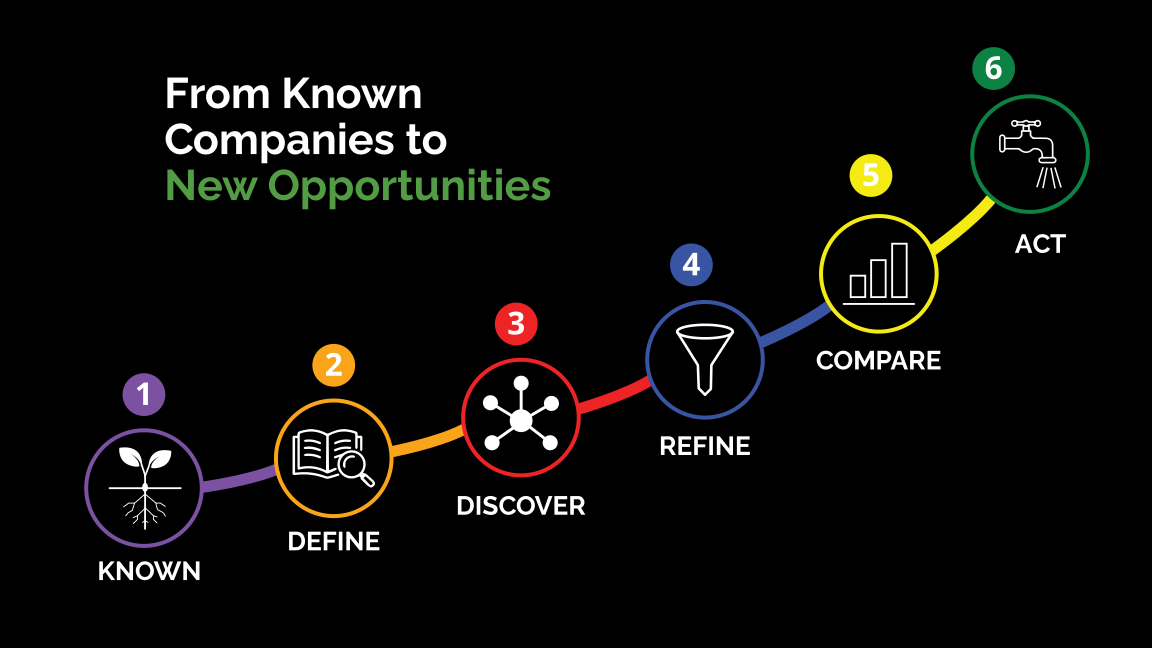
USP Data methodology showing how known companies become new opportunities

Who Uses USP Data?

USP Data is used by private equity investors, corporate acquirers and corporate finance advisers to support deal origination, deal sourcing and market intelligence activities across UK markets. Whether identifying acquisition targets for a buy-side mandate, building buyer lists for a sell-side process or supporting a buy-and-build strategy, the platform provides a structured workflow for market mapping, target identification, buyer research and opportunity management.

Private Equity Investors

  • Buy-and-build programmes
  • Proprietary deal sourcing
  • Market mapping and sector analysis
  • Acquisition pipeline development
  • Identification of fragmented sectors suitable for consolidation

Corporate Acquirers

  • Strategic acquisitions
  • Geographic expansion opportunities
  • Competitor identification and analysis
  • Market consolidation strategies
  • Identification of adjacent markets and acquisition opportunities

Corporate Finance Advisers

  • Buy-side target identification
  • Sell-side buyer list creation
  • Market intelligence and sector research
  • Transaction support and opportunity management
  • Creation of acquisition target and strategic buyer shortlists

Example M&A Deal Origination Workflow

1. Define the Acquisition Brief

Specify the characteristics of the businesses you wish to identify, including sector, geography, turnover, profitability, ownership profile, shareholder age, company size, acquisition rationale and other relevant criteria.

2. Build the Target Universe

Search more than 5.5 million UK companies using financial, geographic, ownership and sector-based filters.

Alternatively, import a list of companies you already know and use USP Data’s researched sector classifications to identify the wider market, uncover competitors, suppliers, customers and adjacent businesses that may also fit your acquisition criteria.

3. Identify Acquisition Candidates

Refine the target universe using ownership intelligence, shareholder demographics, financial performance, company age, size and sector-specific characteristics.

This enables deal teams to focus on businesses that are most closely aligned with the acquisition strategy.

4. Engage Decision Makers

Export company, director and shareholder contact details to support outreach campaigns.

Where email engagement is required, USP Data exports can be used alongside specialist contact providers to identify current email addresses using company names and website domains.

5. Build Strategic Buyer Lists

Identify potential acquirers using sector, financial and ownership intelligence. Detailed buyer-list methodologies are discussed below.

6. Monitor Market Opportunities

Save searches, target lists and acquisition criteria within the integrated CRM.

As company information is updated, deal teams can revisit opportunities, refresh target lists and monitor sectors for emerging acquisition and divestment opportunities.

Building Buyer Lists for Sell-Side Mandates

Identifying potential buyers is often as important as identifying acquisition targets. When preparing a sell-side mandate, advisers need to understand which organisations have the strategic rationale, financial capacity and market presence to complete an acquisition.

A common approach is to begin with the client company using USP Data’s “Find a Firm” tool. From there, advisers can identify sector peers and use financial, geographic, ownership and scale criteria to build a targeted universe of potential acquirers.

USP Data can be used to identify:

• Direct competitors operating in the same market

• Larger businesses pursuing consolidation strategies

• Regional operators seeking geographic expansion

• Adjacent market participants looking to broaden their capabilities

• Businesses with the financial strength to support acquisitions

• Existing sector leaders seeking additional market share

Sector reports and researched sector classifications allow advisers to look beyond direct competitors and explore related markets, suppliers, complementary businesses and substitute providers. This broader perspective often uncovers potential acquirers that would not be identified through SIC code searches alone.

By combining sector intelligence, financial analysis and ownership information, advisers can create highly targeted buyer lists tailored to each transaction and develop a more comprehensive view of the potential acquirer universe.

Beyond SIC Codes: More Accurate Acquisition Targeting

Many company databases rely exclusively on SIC codes to identify businesses operating within a particular market. Whilst useful as a starting point, SIC codes are broad classifications assigned when a company is formed and are often poorly maintained as businesses evolve.

For M&A advisers, this creates two problems. SIC code searches frequently miss relevant companies and often include businesses that have little connection to the market being analysed. The result is larger target lists containing both omissions and irrelevant companies.

USP Data addresses this issue through more than 1,000 researched sector classifications developed using industry association membership lists, trade exhibitions, company websites and other market-specific sources. These classifications are designed to identify businesses based on what they actually do rather than how they classified themselves years ago.

The benefit is particularly significant in niche markets where SIC codes provide poor coverage. More accurate market definition leads to more relevant acquisition targets, stronger buyer lists and more effective deal origination. For more detail, see our guide to industry sector reports and market segmentation.

What USP Data Does

USP Data combines company intelligence, researched sector classifications, workflow tools and an integrated CRM to support acquisition target identification, buyer research, market mapping and long-term deal origination programmes.

How M&A Teams Use Our Deal Origination Software

M&A teams begin with a brief, outlining sectors, firm size, profitability, and other criteria. They apply these filters to the latest data on 5.5 million UK companies on the workspace within USP Data, producing a shortlist in minutes. They can set maximum and minimum values for any of the 42 metrics provided like profitability or employee numbers. Once the shortlist is created, they can view it in templates specifed to display exactly the relevant data for the listed companies.  Using this list view template it is easy to suppress unsuitable firms, export the chosen data or save the list into the built in CRM as a project for later attention.

In practice, the objective is rarely to identify a single shortlist immediately. Successful deal origination programmes are typically built around a broader acquisition universe containing all businesses that could potentially satisfy the acquisition brief. Opportunities can be drawn from multiple adjacent sectors and refined over time as additional research is undertaken. This reduces the risk of overlooking attractive businesses and creates a pipeline that can support acquisition activity over an extended period.

Ownership Intelligence and Transaction Signals

Our deal origination software is updated weekly, capturing changes in 5.5 million companies—from credit scores and new directors to ownership shifts. You can monitor signals like new accounts filed, changes in shareholder structure, or shifts in profitability. These transaction triggers help you spot companies at pivotal moments—whether it’s a strong growth, decline, or leadership change—so you can target them with greater precision using USP Data.

Ownership intelligence can also provide valuable context when prioritising acquisition opportunities. Whilst no data can predict whether a business owner wishes to sell, ownership concentration, shareholder demographics and management structures can help identify businesses where succession planning may become an increasingly important consideration.

CRM and Company Monitoring

USP Data includes a built-in CRM that acts as a central hub for all your projects. Whether you’re evaluating scaffolding firms or exploring legal practices, you can save these lists into the CRM, adding your own contact details, notes, and progress updates. You can monitor interactions, bring the list back into the workspace for further screening, and export updated data. By organising lists in projects, such as top targets or warm leads, you can subtract and refine pools so you do not duplicate effort. Plus, since financial and contact data updates automatically, your lists stay current, making it easy to revisit and track progress over time.

Because acquisition opportunities often develop over months or years, maintaining institutional knowledge is critical. Research findings, website reviews, meeting notes and market intelligence can all be stored against individual companies within the CRM. This creates a central repository of acquisition intelligence that can be revisited as circumstances change and opportunities evolve.

Frequently Asked Questions About Deal Origination Software

What is deal origination software?

USP Data is described as deal origination software because it enables users to search, screen, analyse and monitor more than 5.5 million UK companies using financial, ownership, geographic and sector criteria. Users can apply highly specific financial, ownership, geographic and sector criteria to identify acquisition targets, strategic buyers and companies matching a defined investment or acquisition brief. Company, director and shareholder information can then be exported for further research and outreach. Furthermore, USP Data’s unique sectorisation goes beyond standard SIC codes, providing focused, tailored sectors that save you time compared to broad classifications. In short, USP Data helps users move quickly from an acquisition brief or market research requirement to a structured acquisition universe supported by financial, ownership and sector intelligence.

What is the difference between SIC codes and researched sector classifications?

SIC codes are standard classifications applied to all UK limited companies at inception. They are often chosen in a broad, unrigorous way. In contrast, USP Data’s research sector classifications are a unique feature that provides far greater focus. Instead of just a broad SIC code—like a general heating and ventilation code—USP Data offers dedicated sector reports, such as one for heating and ventilation contractors and another for plumbers. This means, rather than sifting through tens of thousands of firms, you get directly to the relevant ones, saving you time and ensuring you focus on exactly the companies that matter. Plus, USP Data helps you avoid missing key firms that might be misclassified in a random SIC code, ensuring a sharper, more efficient search.

What Users Say

A wonderful product and superb support.

Partner

Used by corporate finance advisers, private equity investors and acquisitive businesses to support acquisition target search, buyer identification, market mapping and long-term deal origination programmes.

See USP Data in Action

USP Data is deal origination software that helps corporate finance advisers, M&A teams, private equity investors and strategic acquirers identify acquisition targets, build buyer lists and uncover transaction opportunities across more than 5.5 million UK companies.

Using financial data, ownership intelligence, researched sector classifications, market mapping and company monitoring tools, users can move from an acquisition brief to a structured acquisition universe and prioritised pipeline of opportunities within minutes.

USP Data combines standard company information with more than 1,000 researched sector classifications, shareholder profiling, keyword search, CRM tracking and comparative analysis tools.

Whether you are sourcing acquisition opportunities, researching niche sectors or building strategic buyer lists, USP Data provides the intelligence needed to identify and monitor the right companies.

Why M&A Teams Use USP Data

The latest data on 5.5 million UK companies

✓ Uniquely: 1,000+ researched sector classifications

✓ Shareholder and ownership intelligence

✓ Acquisition target and buyer identification tools

✓ Integrated CRM and company monitoring to save time

✓ Comparative analysis and reporting and unlimited exporting of relevant data

Understanding the Role of USP Data in Deal Origination

USP Data is designed to help advisers identify acquisition opportunities, build buyer lists, analyse markets and prioritise outreach activity. However, successful deal origination still relies on professional judgement and relationship-building.

USP Data does not identify confirmed sellers or predict future transactions. Instead, it helps advisers identify businesses displaying characteristics that may indicate ownership change, succession planning, strategic review or acquisition potential.

The platform is based primarily on publicly available Companies House filings and other business information sources. As a result, the quality and depth of information available for individual companies depends upon the information those companies choose or are required to disclose.

USP Data does not provide private email addresses or confidential transaction information. Where email outreach forms part of a campaign, many users combine USP Data exports with specialist contact data providers to obtain current business email addresses.

The platform is intended to support and enhance the deal origination process rather than replace adviser expertise. The most successful users combine market knowledge, sector expertise and relationship-building skills with the intelligence and targeting capabilities provided by USP Data.