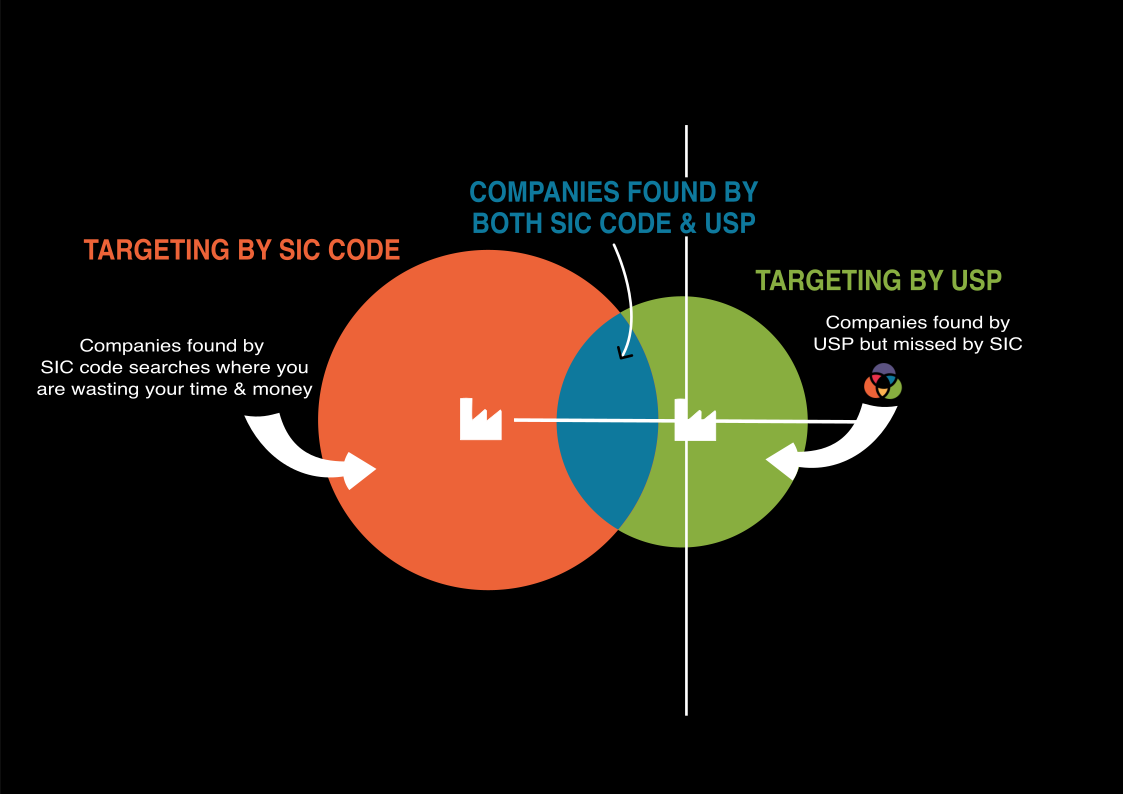
Finding better acquisition targets than SIC codes allow requires a more accurate approach to market definition and acquisition research. However, SIC codes were never designed for acquisition research. Whilst they can provide a useful starting point, they often group together businesses with very different activities and can overlook specialist companies that may represent attractive acquisition opportunities.
For acquirers, investors and corporate finance advisers, the quality of acquisition research depends heavily on the quality of market definition. If the underlying company population is incomplete or inaccurate, every subsequent stage of target identification becomes less effective.
Why SIC Codes Can Limit Acquisition Research
Many acquisition searches begin with SIC codes because they are readily available and universally applied across UK companies. They provide a convenient starting point for identifying businesses operating within a broad industry category. However, SIC codes were created primarily for administrative and statistical purposes rather than acquisition research.
The challenge is that many industries contain a wide variety of businesses that share the same SIC code despite offering very different products, services and market positions. As a result, acquisition teams can find themselves reviewing large numbers of irrelevant companies whilst simultaneously overlooking specialist businesses that may represent attractive acquisition opportunities.
This issue becomes more significant when researching fragmented industries or niche sectors. Companies that operate in highly specialised markets are often grouped together with broader industry participants, making it difficult to identify the businesses that genuinely fit an acquisition strategy. In some cases, businesses may even select broad SIC codes that only partially reflect their actual activities.
For acquisition research, the objective is not simply to identify companies within a broad classification. It is to identify the businesses that genuinely operate within the target market. If the initial company population is incomplete or poorly defined, every subsequent stage of the acquisition process becomes less effective. Financial analysis, ownership screening and opportunity prioritisation can only be as good as the underlying market definition.
This is why many acquirers move beyond standard classifications and seek more focused ways of identifying companies within specific markets. Access to comprehensive company information, ownership data and researched sector classifications provides a stronger basis for acquisition research than SIC codes alone. The more accurately the target market is defined, the more likely it becomes that acquisition opportunities will be identified rather than overlooked.
The Hidden Cost of Broad Classifications
At first glance, broad industry classifications may appear to provide a comprehensive view of a market. The reality is often very different. When acquisition teams rely on overly broad classifications, they can find themselves reviewing large populations of businesses that have little relevance to their acquisition objectives.
This creates two distinct problems. The first is inefficiency. Time and resources are spent researching companies that ultimately fall outside the desired market, reducing the effectiveness of the acquisition process and increasing the effort required to identify suitable targets.
The second problem is more significant. Broad classifications can obscure specialist businesses that may represent some of the most attractive acquisition opportunities within a market. When niche operators are grouped together with larger and more diverse company populations, they become harder to identify and can easily be overlooked during the screening process.
For example, an acquirer seeking businesses within a specialist professional services sector may find that relevant companies are dispersed across several broad classifications. Whilst thousands of companies may appear within the search results, the businesses that genuinely fit the acquisition criteria can remain hidden within the wider population. As a result, the acquisition universe becomes incomplete before financial analysis, ownership screening or prioritisation have even begun.
The consequences extend beyond target identification. Inaccurate market definition can distort competitor analysis, market mapping exercises and sector research projects. Strategic decisions may be based on incomplete information simply because the underlying company population does not accurately reflect the market being analysed.
The objective of acquisition research should be to identify every business that could represent a relevant opportunity. The more focused and accurate the market definition, the greater the likelihood that valuable acquisition targets will be identified and included within the acquisition universe. Conversely, broad classifications increase the risk that important opportunities remain hidden from view.
Specialist Sectors Reveal Opportunities That SIC Codes Miss
Many industries contain specialist niches that are difficult to identify using broad classification systems alone. Whilst companies may operate within the same general market, the services they provide, customer bases they serve and competitive environments they operate within can be very different.
For acquisition teams, these distinctions matter. A business seeking to acquire a specialist wealth management firm, land surveying practice, insurance intermediary or heating and ventilation contractor is unlikely to benefit from reviewing thousands of companies grouped together within a broad industry classification. The objective is to identify the businesses that genuinely participate within the target market rather than every company that shares a similar administrative code.
Specialist sector research allows markets to be viewed at a much more focused level. Rather than relying solely on broad classifications, researchers can use detailed industry sector reports to identify companies operating within specific market niches and specialist subsectors. By identifying companies based on their actual activities rather than relying solely on broad classifications, acquisition teams can uncover businesses that may otherwise remain hidden within larger company populations.
The benefits extend beyond target identification. More focused sector definitions improve competitor analysis, market mapping and strategic planning by providing a clearer understanding of the businesses operating within a particular market niche. Acquisition universes become more relevant, research becomes more efficient and opportunities are less likely to be overlooked.
For organisations pursuing acquisition-led growth, the ability to identify specialist businesses can provide a significant advantage. The most attractive opportunities are not always the most visible. In many cases they are hidden within broader classifications and only become apparent when the market is analysed at a more granular level.
Accurate sector definition therefore becomes more than a research exercise. It becomes a method of uncovering acquisition opportunities that may never appear within a traditional SIC-code-based search.
Industry Professionals Value Accurate Sector Classification
“It is unusual to get a report specifically for Land Surveyors. Normally we get included with Surveyors and Valuers.”
Operations Manager
“We have begun working through the report on Insurance Intermediaries and it looks excellent.”
Managing Director
Better Market Definition Creates Better Acquisition Universes
The quality of an acquisition universe is determined long before financial screening, ownership analysis or target prioritisation begins. It starts with the quality of the market definition used to identify the initial population of companies.
If the market is defined too broadly, acquisition teams can spend considerable time reviewing businesses that have little relevance to their objectives. If it is defined too narrowly, attractive opportunities may be excluded altogether. In either case, the acquisition universe becomes less effective as a foundation for deal origination activity.
A well-defined market creates a more accurate acquisition universe by ensuring that the businesses being researched genuinely operate within the target sector. This provides a stronger foundation for acquisition target search because the resulting company population is more relevant to the acquisition strategy. It also provides a stronger basis for subsequent analysis and allows acquisition teams to focus their efforts on companies that are strategically relevant from the outset.
The benefits become increasingly apparent as additional layers of intelligence are applied. Financial screening can be used more effectively when it is focused on the right population of companies. Ownership analysis becomes more meaningful when applied to businesses that genuinely fit the acquisition strategy. Opportunity prioritisation becomes more accurate because it is based on a more complete view of the market.
Perhaps most importantly, a well-constructed acquisition universe reduces the risk of overlooking opportunities. Many acquisition programmes focus heavily on identifying a shortlist of potential targets, but the most successful acquirers often begin by creating a broader population of relevant businesses that can be researched, monitored and prioritised over time.
Market definition is therefore not simply the first stage of acquisition research. It underpins every subsequent stage of the process. The more accurately a market is defined, the more effective the acquisition universe becomes as a tool for identifying, evaluating and developing future acquisition opportunities.
From Market Definition to Acquisition Intelligence
Successful acquisition programmes are built on more than company data alone. They rely on acquisition intelligence that enables opportunities to be identified, evaluated and prioritised more effectively than would be possible through broad market searches or generic company lists.
Accurate market definition forms the foundation of this process. By identifying the right population of companies from the outset, acquisition teams create a stronger basis for every subsequent stage of research. Financial analysis becomes more meaningful, ownership intelligence becomes more relevant and opportunity prioritisation becomes more effective because all activities are focused on businesses that genuinely operate within the target market.
This is where acquisition research begins to evolve into acquisition intelligence. Rather than simply identifying companies that share a broad classification, acquirers develop a structured understanding of the market, the businesses operating within it and the factors that influence future transaction opportunities. The objective shifts from generating company lists to identifying businesses that are strategically attractive, commercially relevant and potentially attainable.
Over time, this intelligence can be refined and expanded. Ownership structures change, companies grow or contract, new market participants emerge and acquisition priorities evolve. A well-defined acquisition universe provides a framework for monitoring these developments and identifying opportunities as they arise rather than waiting for them to become obvious.
The most successful acquirers recognise that finding acquisition opportunities is not simply a search exercise. It is an ongoing process of building market knowledge, identifying patterns, evaluating opportunities and maintaining a pipeline of potential transactions. Better market definition supports that process by ensuring that acquisition intelligence is built upon the most accurate and relevant understanding of the market possible.
By moving beyond broad classifications and focusing on how industries operate in practice, acquisition teams can uncover opportunities that might otherwise remain hidden, create stronger acquisition universes and develop a more effective foundation for long-term deal origination activity.
Build Better Acquisition Universes
USP Data combines 1,000+ researched industry sectors, financial screening, ownership intelligence and acquisition target search tools to help acquirers identify opportunities that SIC codes often miss.
Request a free trial or contact us to discuss your acquisition criteria.
Link to:
 © 2026 Unique Sector Performance Data Ltd.