
Access to company information has never been easier. The challenge facing corporate finance advisers, private equity investors and acquisitive businesses is not finding company data but identifying which businesses represent genuine acquisition opportunities.
Most company databases can generate lists of businesses. Far fewer help users understand which companies are strategically attractive, which ownership structures may indicate future transaction opportunities and which businesses deserve immediate attention. Acquisition intelligence is created when sector research, financial analysis and ownership intelligence are combined to identify and prioritise opportunities within a market.
Successful deal origination programmes are therefore built on more than company data alone. They rely on a structured process that transforms research into actionable acquisition intelligence and a pipeline of potential opportunities.
Start with the Right Market
Effective acquisition research begins with a clear definition of the target market. Before financial screening, ownership analysis or target prioritisation can take place, acquisition teams must first identify the population of businesses that genuinely operate within the market they wish to enter, consolidate or expand.
Defining the market too broadly can result in thousands of irrelevant companies being included in the research process, whilst defining it too narrowly risks overlooking attractive opportunities. The objective is to create an accurate representation of the market that reflects how businesses actually operate rather than relying solely on broad administrative classifications.
Once the appropriate market has been identified, a more meaningful acquisition universe can be created. This ensures that subsequent financial analysis, ownership research and opportunity prioritisation are focused on companies that are genuinely relevant to the acquisition strategy.
The quality of every acquisition programme is influenced by the quality of the initial market definition. The more accurately the market is identified at the outset, the more effective every subsequent stage of research becomes.
Build an Acquisition Universe
Many acquisition programmes begin with the objective of creating a shortlist of potential targets. Whilst shortlists are useful, they often encourage a narrow view of the market and can result in attractive opportunities being overlooked. The most successful acquirers typically start by building a broader acquisition universe before deciding which companies deserve immediate attention.
An acquisition universe is a structured population of businesses that meet the broad strategic criteria of the acquisition programme. Rather than focusing on a handful of companies, it captures all organisations that could potentially represent acquisition opportunities based on their market position, scale, ownership profile or geographic presence.
This broader approach recognises that acquisition opportunities develop over time. Businesses that are not receptive to discussions today may become attractive opportunities in the future due to changes in ownership, succession planning considerations, strategic priorities or market conditions. By maintaining a comprehensive acquisition universe, acquirers can monitor a wider range of businesses and avoid relying on a small number of immediate prospects.
Building an acquisition universe also creates a stronger foundation for subsequent analysis. Financial screening, ownership intelligence and strategic assessment become more valuable when applied across a well-defined population of relevant businesses rather than a limited shortlist created too early in the process.
The objective is not simply to identify companies that match today’s acquisition criteria. It is to create a long-term framework for identifying, evaluating and prioritising opportunities as they emerge. In this way, an acquisition universe becomes a strategic asset that supports ongoing deal origination activity rather than a one-off research exercise.
Layer Financial and Ownership Intelligence
Once an acquisition universe has been established, the next challenge is determining which businesses deserve closer attention. Financial analysis provides an important starting point, helping acquirers identify companies that match their preferred size, performance profile and strategic objectives. Criteria such as turnover, profitability, employee numbers, growth rates and financial stability can all be used to narrow the field and identify businesses that appear attractive on paper.
However, financial performance alone rarely determines whether a company represents a realistic acquisition opportunity.
Two businesses may have similar turnover, profitability and market position, yet present very different acquisition prospects. One may be owned by a founder approaching retirement with no obvious succession plan, whilst the other may form part of a larger corporate group with no intention of divesting the business. Financially they may appear almost identical, but from an acquisition perspective they are fundamentally different opportunities.
This is where ownership intelligence becomes particularly valuable. Understanding who owns a business, how ownership is structured and whether control is concentrated amongst a small number of shareholders can provide important clues about future transaction potential. Owner-managed businesses, family-owned companies, subsidiary operations and businesses with changing ownership structures can all present different acquisition dynamics that are not visible through financial analysis alone.
By combining financial screening with ownership intelligence, acquisition teams can move beyond identifying attractive businesses and begin identifying businesses that are more likely to become acquisition opportunities. This creates a more informed basis for prioritisation and allows resources to be focused on companies that are both strategically attractive and realistically attainable.
The most effective acquisition intelligence is therefore created by combining multiple layers of information. Financial analysis helps identify businesses of the right scale and performance profile, whilst ownership intelligence provides insight into the people, relationships and structures that often determine whether a transaction is likely to occur.
Prioritise Opportunities Rather Than Creating Lists
One of the most common weaknesses in acquisition research is the tendency to treat every company identified during the search process as an equal opportunity. In reality, acquisition teams rarely have the time or resources to investigate every business in detail. The challenge is not simply identifying companies but determining which opportunities deserve immediate attention and which should remain part of a longer-term pipeline.
This is where acquisition intelligence differs from company data. A database may be capable of producing hundreds of potential targets, but effective deal origination requires a structured method for evaluating and prioritising those opportunities. Companies should be assessed against the strategic objectives of the acquisition programme, taking into account factors such as financial performance, market position, ownership structure, geographic fit and growth potential.
Ownership intelligence often plays a particularly important role in this process. Two businesses may appear equally attractive financially, yet one may be significantly more likely to engage in acquisition discussions due to succession planning considerations, shareholder dynamics or changing ownership circumstances. Understanding these factors allows acquisition teams to focus their efforts where there is the greatest likelihood of future engagement.
Prioritisation also enables resources to be allocated more effectively. High-priority opportunities can be researched in greater depth and monitored more closely, whilst other businesses remain within the wider acquisition universe for future review. This creates a balanced acquisition pipeline containing opportunities at different stages of development rather than relying on a small number of immediate prospects.
Successful deal origination is therefore not about creating the longest possible list of companies. It is about identifying the businesses that are most strategically attractive, most relevant to the acquisition criteria and most likely to become future transaction opportunities. The ability to prioritise opportunities effectively is what transforms company research into actionable acquisition intelligence.
Transform Research into a Deal Origination Programme
The ultimate objective of acquisition research is not simply to identify potential targets. It is to establish a repeatable process that consistently generates, evaluates and develops acquisition opportunities over time. This is the point at which company research becomes a structured deal origination programme.
Many acquisition projects begin with a specific requirement or immediate transaction objective. Whilst this approach can produce opportunities, it often results in a reactive process where targets are identified only when a need arises. The most successful acquirers take a longer-term view by building and maintaining acquisition intelligence that continuously supports opportunity identification and prioritisation.
This process begins with defining the right market and creating a comprehensive acquisition universe. Financial analysis and ownership intelligence can then be used to identify businesses that align most closely with the acquisition strategy. Rather than producing a one-off target list, the result is a structured population of opportunities that can be monitored, reassessed and prioritised as circumstances change.
Over time, markets evolve. New financial accounts are filed, ownership structures change, businesses expand into new areas and succession planning considerations emerge. Companies that may not represent immediate opportunities today can become highly attractive prospects in the future. Maintaining acquisition intelligence allows these developments to be identified and incorporated into the deal origination process.
This creates a stronger and more resilient acquisition pipeline. Rather than relying on a small number of active opportunities, acquisition teams can maintain a broader population of prospects at different stages of development. Some businesses may warrant immediate engagement, whilst others remain under review pending changes in ownership, performance or strategic direction.
Successful deal origination is therefore an ongoing discipline rather than a one-off research exercise. By combining market knowledge, financial analysis and ownership intelligence, acquirers can build a continuously evolving pipeline of opportunities that supports long-term acquisition growth and improves the likelihood of identifying the right opportunities at the right time.
Conclusion
Access to company information is only the starting point. The real value comes from transforming company data into acquisition intelligence that can be used to identify, evaluate and prioritise opportunities more effectively.
By defining the right market, building a comprehensive acquisition universe, applying financial and ownership analysis and prioritising opportunities systematically, acquisition teams can move beyond simple target identification and develop a structured deal origination process.
The most successful acquisition programmes are not built around individual opportunities. They are built around acquisition intelligence that enables opportunities to be identified earlier, evaluated more effectively and developed into a sustainable pipeline of future transactions.
Latest articles
Using Business Segmentation to Identify Better Acquisition Targets
Identifying the right acquisition targets is one of the most important stages of any deal origination programme. Effective business segmentation enables acquirers to focus on companies that match specific financial, sector, geographic and ownership criteria, helping to build targeted acquisition pipelines and uncover opportunities that might otherwise be overlooked. Rather than screening thousands of companies…
Continue reading...Using Business Segmentation to Identify Better Acquisition Targets
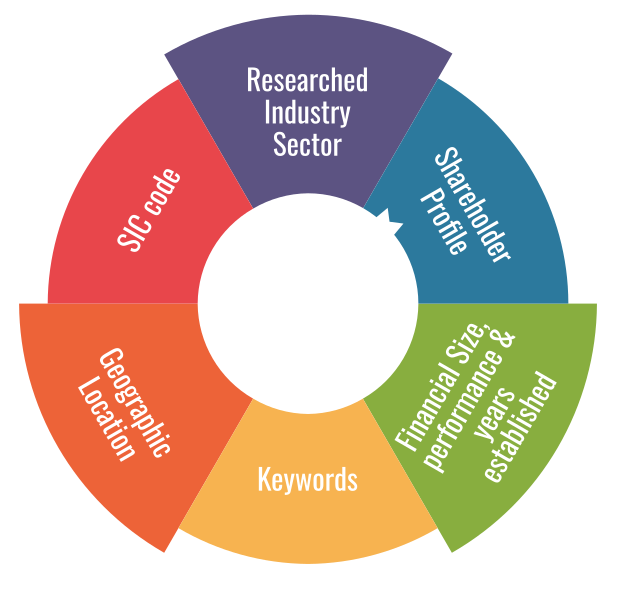
Most acquisition programmes begin by defining a target market. However, effective market definition requires more than a simple SIC code search. Businesses can be segmented using multiple criteria including industry activity, geography, size, ownership structure and financial performance. The more accurately a market is segmented, the easier it becomes to identify acquisition opportunities that align…
Continue reading...Finding Better Acquisition Targets Than SIC Codes Allow

Finding better acquisition targets than SIC codes allow requires a more accurate approach to market definition and acquisition research. However, SIC codes were never designed for acquisition research. Whilst they can provide a useful starting point, they often group together businesses with very different activities and can overlook specialist companies that may represent attractive acquisition…
Continue reading...Find Company Information quickly with the USP Data App

Accelerating Deal Origination Deal Origination is made easier with the USP Data app. Because the universe of live UK companies is large we have included industry leading firmographic data selection tools to help you sift this mass of data to find company information you can rely on. The idea is that you can quickly screen…
Continue reading...Unveiling the Power of Niche Market Identification for Business Success
In a competitive SME business landscape, understanding and identifying relevant market niches is key. Of the 5 million plus limited companies live at Companies House there are probably only 1.7 million or so that are not dormant, intermediate holding companies or property management firms. This is still a considerable number to trawl through when attempting…
Continue reading...How to make Due Diligence easy

Assessment of business plans, corporate acquisitions or disposals and refinancing will all require due diligence investigations to confirm the facts being represented in the matter under consideration. This will require a tool or series of tools which allow an independent audit of the information being presented so that it may be confirmed in both hard…
Continue reading...Lead Building – sifting the wheat from the chaff

The sales funnel is a familiar concept which tracks the conversion of new contacts from suspects to leads to prospects and then to customers. This is typically represented as a cone with lots of leads being fed into the top of the cone and a much smaller number of customers resulting at the bottom. The…
Continue reading...Unlocking the opportunities hidden in abbreviated accounts

As you know Company Law allows “Small Companies” an option of disclosing less information at Companies House. This means that there is imperfect information in the public domain for SME firms. Companies House is the only verifiable source of financial data on privately held companies. As a result most of the attention is on the…
Continue reading...Valuing Companies Guide

Valuation is a tricky business! In a world of perfect information all risks are known, alternatives can be compared with certainty and cashflows can be discounted to provide the value of a firm. AI could be used to accurately land on a valuation which accounted for all the factors. It is clear that such perfect…
Continue reading... © 2026 Unique Sector Performance Data Ltd.